


65W GaN USB-C Wall Charger: PD + Quick Charge Guide
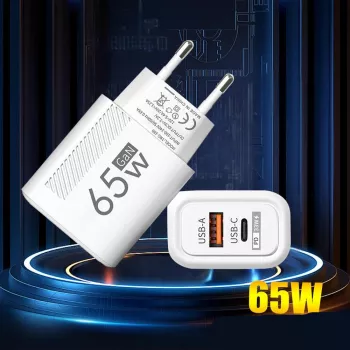
65W GaN USB-C Fast Wall Charger with Quick Charge: compact power for everyday devices
A compact 65W GaN wall charger can replace multiple bulky adapters while delivering fast, stable power to phones, tablets, and many laptops. This guide breaks down what 65W means in real use, how Quick Charge and USB Power Delivery relate, and what to check for compatibility, safety, and everyday convenience.
What a 65W GaN wall charger is built to do
A 65W charger is designed to deliver up to 65 watts of power to a connected device when that device can accept it. For many people, that “up to” is the difference between carrying one charger versus packing a laptop brick plus a separate phone adapter.
- Faster charging on compatible gear: Up to 65W can cover many USB-C laptops, tablets, and modern phones that support fast charging.
- GaN efficiency: Gallium nitride (GaN) components tend to run more efficiently than many older silicon designs, helping reduce heat and enabling a smaller, travel-friendly body.
- Wall-outlet convenience: As a dedicated wall charger, it’s ideal for desks, nightstands, airports, and hotels—especially when paired with a cable rated for the power level you need.
USB Power Delivery vs Quick Charge: compatibility basics
Fast charging isn’t “one size fits all.” The charger and the device negotiate how much power to send, and the protocol they agree on determines charging speed.
- USB Power Delivery (USB-PD): The most common fast-charging standard over USB-C for many phones, tablets, power banks, handheld consoles, and laptops.
- Quick Charge: A fast-charging family frequently associated with Android phones. Some chargers support both USB-PD and Quick Charge behaviors depending on the connected device and the port design.
- Cable matters: Best results come from matching the device’s supported standard and using a cable rated for the required power (for higher wattage, use a USB-C to USB-C cable designed for PD).
- Non-fast-charge devices still work: If a device doesn’t support fast charging, it will still charge safely—just at its normal pace.
Fast-charging standards at a glance
| Standard | Typical devices | Connector/cable notes | What to confirm before buying |
|---|---|---|---|
| USB Power Delivery (USB-PD) | USB-C phones, tablets, many laptops and accessories | USB-C to USB-C cable; higher wattage may require an e-marked cable | Device supports PD profiles; cable is rated for the needed wattage |
| Quick Charge | Many Android phones and accessories | Often works via USB-A or USB-C depending on charger | Phone model supports QC version; use a quality cable |
| Basic USB charging | Older devices and low-power accessories | Any standard USB cable | Expect slower charging speeds |
For deeper background on the standards themselves, see the official USB-IF overview of USB Power Delivery and Qualcomm’s Quick Charge technology page.
Real-world charging expectations (what 65W can cover)
“65W” is a capacity rating, not a constant output. Your device requests what it can use, and the charger supplies that level (up to its maximum).
- Phones: Many phones peak well below 65W, but a higher-capacity charger can still deliver strong fast-charge performance when the phone requests it—especially during that initial “top-up” window.
- Tablets: Larger batteries often benefit from higher PD wattage support, making it easier to add meaningful battery during short breaks.
- Laptops: Many USB-C laptops charge comfortably at 45–65W. Performance or creator laptops may want more than 65W to charge at full speed while under heavy load.
- One charger, many devices: A single higher-wattage charger can rotate between a phone, tablet, and laptop without keeping separate adapters for each.
What to look for before plugging in
Quick compatibility checklist
| Check | Why it matters | How to verify |
|---|---|---|
| Your device supports USB-PD or Quick Charge | Enables faster charging speeds | Look up the device charging spec or the original charger rating |
| Correct cable type and rating | Prevents power bottlenecks | Use USB-C to USB-C for PD; choose a cable rated for higher wattage when needed |
| Your laptop’s required wattage | Avoids slow charging under load | Check laptop charger label or manufacturer specs |
| Outlet and travel needs | Ensures safe use abroad | Confirm input voltage range and carry a plug adapter if required |
Safety and performance features that matter day to day
For a broad reference on safety expectations around modern AV/ICT equipment, the IEC maintains information related to IEC 62368-1 on its standards portal.
When a 65W charger is the right choice (and when it isn’t)
Product details and quick reference
If you want a compact wall charger that can cover many everyday USB-C charging needs, the 65W GaN USB C Fast Wall Charger with Quick Charge is a straightforward option for home, office, or travel. Pair it with a reputable cable that matches your device’s charging standard and wattage needs.
Also in stock at Top Bargains World
- Mini USB Aroma Humidifier & Essential Oil Diffuser with Soft LED Light
- Car Plastic & Leather Restorer – Back to Black Gloss Coating & Polish
FAQ
Will a 65W charger fast-charge an iPhone or iPad?
Many Apple devices use USB Power Delivery for fast charging. With the right cable (USB-C to USB-C for iPads with USB-C, or USB-C to Lightning for older iPhones), the device will draw only the wattage it supports—65W is the maximum available, not a constant output.
Can a 65W USB-C charger power a laptop safely?
Yes, when the laptop supports USB-C charging, USB-PD negotiation helps ensure safe power delivery. If your laptop is designed for 45–65W charging, it should charge normally; if it requires more, it may charge slowly or maintain battery under light use.
Does Quick Charge work with any USB-C cable?
Many cables will work, but quality and rating affect stability and speed. For reliable fast charging, use a reputable cable in good condition, and remember the device must support Quick Charge to see Quick Charge-level speeds.















Leave a comment